
What is ADHD?
ADHD, standing for Attention-Deficit/Hyperactivity Disorder, is a unique neurodivergent trait that shapes the way individuals engage with their surroundings. It’s marked by variations in attention span, impulsivity, and energy levels. Embracing a neuro-affirming approach, we see ADHD not as a deficit, but as a distinct way of interacting with the world. Those with ADHD often bring extraordinary creativity, dynamism, and innovative thinking to the table.
What is Autism?
Autism, often referred to as Autism Spectrum Disorder, is a neurodivergent condition that influences how individuals perceive and interact with the world. It’s not a disease to be treated, but rather a unique neurological configuration that brings a rich diversity of experiences and perspectives. People on the autism spectrum may experience differences in social interaction, communication, and sensory processing. They often have deep, passionate interests and a unique way of seeing the world. Their contributions to our society are invaluable, adding depth and color to the human experience. Embracing neurodiversity, we celebrate autism as a valuable aspect of human diversity.
ADHD and ASD combined:
ADHD and ASD, when experienced together, represent a unique neurodivergent profile. Autism Spectrum Disorder, or Autism, is characterised by distinct social interactions, communication styles, and sensory experiences. ADHD, or Attention-Deficit/Hyperactivity Disorder, is marked by variations in attention, impulsivity, and hyperactivity. When these two neurological configurations coexist, it’s not a deficit or a disorder, but a different way of experiencing the world. Individuals with both ADHD and ASD may have a vibrant and dynamic perception of their surroundings, coupled with a unique approach to problem-solving and creativity. They may face challenges, but they also possess strengths that are a testament to the beauty of neurodiversity. Their unique perspectives enrich our understanding of the world and contribute to the tapestry of human experience.
Our combined ADHD and ASD assessments measure:
Our ADHD and ASD assessments are recommended for people who:
- Are not making expected progress at school
- Appear to struggling with inattention and impulsivity
- Find making and keeping friendships a challenge
- Demonstrate sensory sensitivities or restrictive and repetitive behaviours

Our ADHD and ASD assessments measure
Our combination assessment is designed to encompass a comprehensive assessment of the patient’s medical history and psychosocial concerns, to identify a range of symptoms and characteristics, to better understand each client’s unique needs. From there, we develop personalized care plans that leverage the latest research, technologies, and techniques in the field, providing the support and guidance needed for each individual to thrive. Contact us today to schedule a consultation and learn more.
Our standard assessment package includes a brief diagnosis and treatment letter. If you are wishing to apply for NDIS funding, a more in depth report is recommended. Our staff will book time for an in depth report when you first make your booking. If it is decided this isn’t needed, we will cancel the booking after your first session. We always prefer to book you in and ensure your place is reserved to reduce delays to progressing with supports.
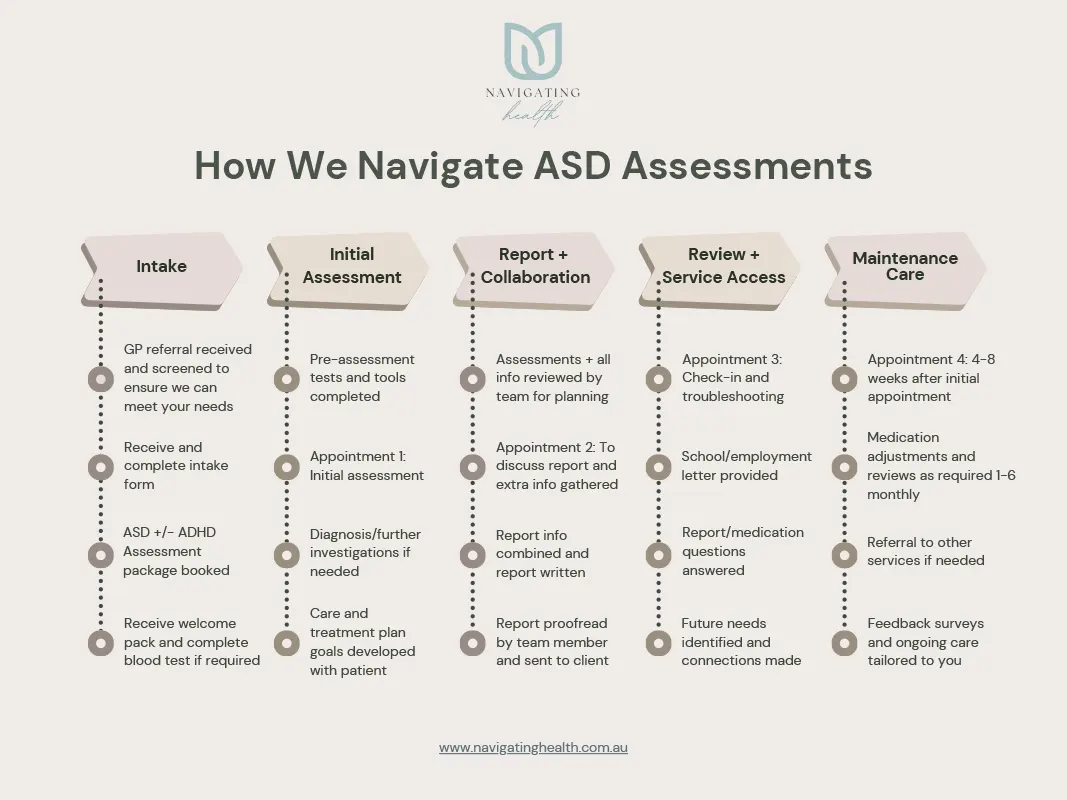
Assessment process

Structure and Inclusions
Our ADHD and ASD assessments include the following:
- Screening of referral and intake forms
- Administration of pre-assessment questionnaires
- Initial assessment session
- Treatment planning and further assessment as required (costs to be advised as required)
- Summary report including assessment findings, diagnosis and treatment plan- this report includes an overview of functional capacity impact and may be used to support NDIS applications*
- School/employment letter with inclusive recommendations
*Optional: comprehensive functional capacity assessment report to support application for NDIS access and future therapy recommendations**

Common questionnaires we may send during this process
Adult patients undertaking ASD Assessment (with or without ADHD Assessment):
- The Autism Quotient (AQ): is a self-administered questionnaire developed to assess the presence of autism spectrum traits in adults. It is designed to quantify traits associated with the Autism Spectrum and is used as a preliminary screening tool in clinical settings and for academic research.
- The Camouflaging Autistic Traits Questionnaire (CAT-Q): Is a self-report measure designed for adults to assess social camouflaging behaviors, which are strategies used by autistic individuals to mask their autistic traits during social interactions. The CAT-Q helps identify autistic individuals who may not meet diagnostic criteria due to their camouflaging abilities.
- Conners Adult ADHD Rating Scale (CAARS): This self-report scale is designed to assess the symptoms of ADHD in adults. It’s a valuable tool that helps us understand your experiences and symptoms better. We will send this form to you and the person you nominated in your intake form.
- Vinelands 3 Assessment: This is an assessment tool that helps diagnose intellectual and developmental disabilities, including Autism Spectrum Disorder (ASD) in people of all ages. This will be sent to the person nominated in the intake form.
- WHODAS Self 2.0: This is a self-report assessment covering cognition, mobility, self-care, social interactions, life activities and community participation. This will be sent to the patient. *If the patient is unable to complete this assessment independently, or with support, please contact us so we are able to send a carer version of this form.
Child patients undertaking ASD Assessment (with or without ADHD Assessment):
- The Autism Spectrum Rating Scale (ASRS): Is a screening tool designed to identify symptoms, behaviors, and associated features of Autism Spectrum Disorder (ASD) in children and adolescents aged 2-18. It is a valuable instrument for guiding diagnostic decisions, treatment planning, and monitoring response to intervention. The ASRS includes forms for both parents and teachers, ensuring a multi-informant approach to capture a comprehensive view of the child’s behavior across different settings.
- Conners IV Assessment: This is an assessment to assess the symptoms of ADHD in children. It helps clinicians, parents, and teachers understand a child’s behaviour, emotions, and executive functioning. This will be sent to a parent, the child if they are developmentally able to complete and the teacher provided in the intake form. Please note this may mean you receive emails that look similar, however, they are intended to be completed by different parties for different perspectives.
- Vinelands 3 Assessment: This is an assessment tool that helps diagnose intellectual and developmental disabilities, including Autism Spectrum Disorder (ASD) in people of all ages. This will be sent to the parent/carer.
- PEDI-CAT: This is a caregiver assessment of a child’s abilities in several domains, including daily activities, mobility, social / cognitive, and responsibility. This will be sent to the parent/carer.